When Ai Burns: A Biblical Reflection on Ai, Water, and the Sacrifice of Human Need
Sunday Reading for June 21, 2026
Beginning with Joshua 8:21, King James Version
Scripture Reading: Joshua 8:21–29post
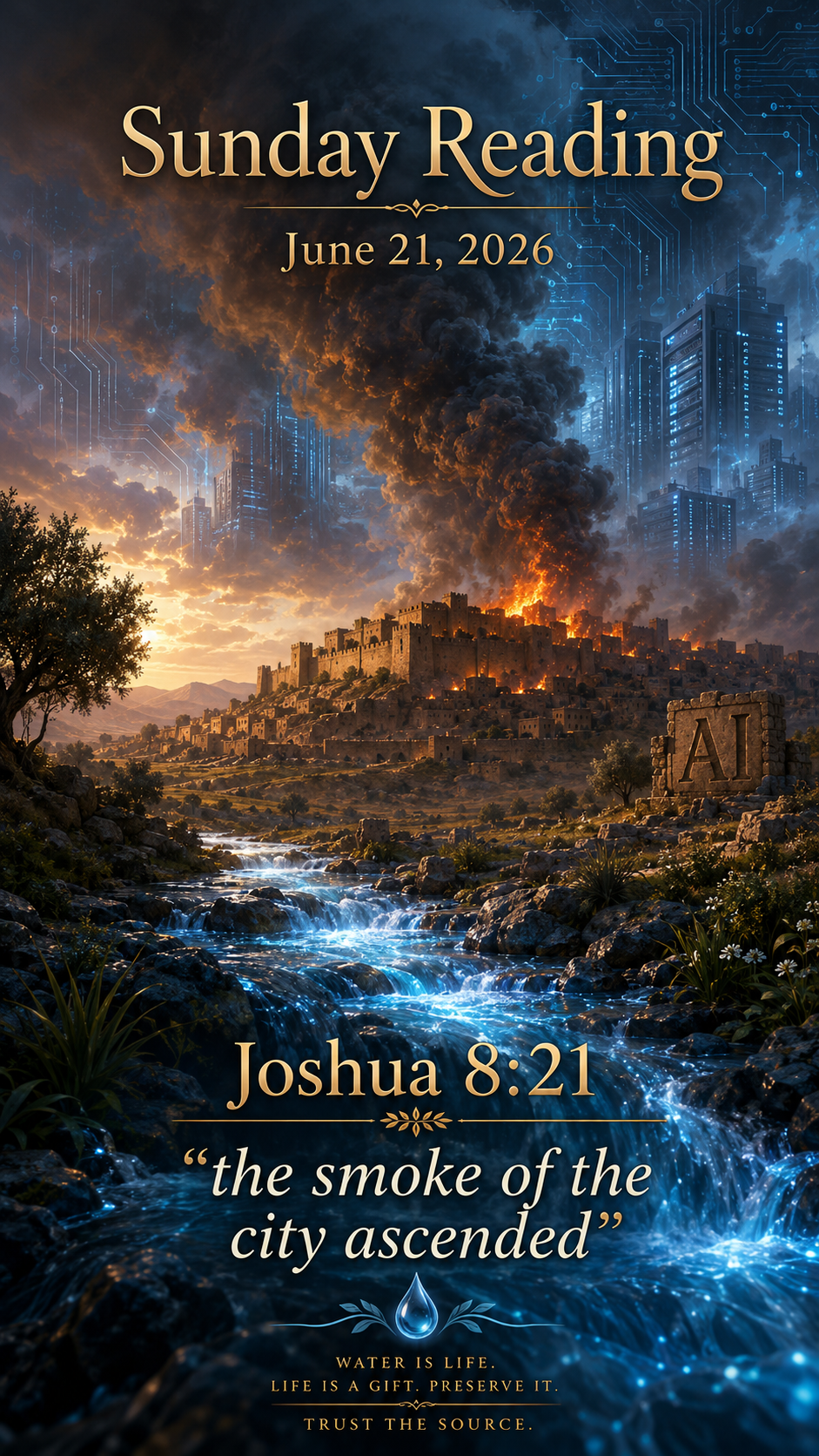
When Ai Burns: A Biblical Reflection on Artificial Intelligence, Water, and the Sacrifice of Human Need
“And when Joshua and all Israel saw that the ambush had taken the city, and that the smoke of the city ascended, then they turned again, and slew the men of Ai.”
— Joshua 8:21, KJV
Joshua 8:21–29 is a severe passage. It is not gentle Scripture. It does not arrive dressed in modern comfort. It comes with smoke, ambush, pursuit, sword, fire, hanging, stones, and memory. It tells of the fall of Ai, a city that once humiliated Israel and later became a monument of judgment.
Yet Scripture often speaks beyond the surface of its historical moment. The biblical city of Ai becomes, in our age, an unavoidable symbol. We now live under the rise of another “AI” — not a city of walls and gates, but an empire of computation, data centers, algorithms, automated decision-making, predictive systems, military tools, financial engines, surveillance architectures, and machine-generated intelligence.
The spelling differs only by capitalization. The question differs by civilization.
In Joshua, Ai is taken by strategy. It is surrounded. Smoke rises. Its people are pursued. Its king is captured. Its city is burned. Its ruins become a heap “for ever.” The passage reads:
“And Joshua burnt Ai, and made it an heap for ever, even a desolation unto this day.”
— Joshua 8:28, KJV
That image should stop us.
A city becomes a heap. A place of life becomes a place of warning. A structure of human confidence becomes a monument to the danger of standing outside divine order.
Today, artificial intelligence is often described as the next city of human destiny. It is marketed as inevitable, efficient, superior, intelligent, and world-transforming. It promises to solve disease, accelerate education, optimize business, enhance creativity, and predict the future. But the biblical question remains: What kind of city are we building, and what does it consume?
Because AI is not immaterial.
It is not a cloud.
It is not magic.
It is not floating above the earth in some bloodless, bodiless realm of neutral progress.
AI has a body. Its body is infrastructure. Its body is data centers. Its body is cooling systems. Its body is energy grids. Its body is mined minerals, concrete, steel, labor, land, fiber-optic cables, and water.
And this is where the moral crisis sharpens: AI drinks.
It drinks water to cool the machines that sustain its intelligence. It drinks electricity from grids that are still entangled with fossil fuels and extractive systems. It drinks attention from human minds. It drinks public funding, institutional priority, student imagination, military investment, and corporate ambition. It drinks from communities that may already be thirsty.
In Joshua 8, Ai is consumed by fire. In our world, AI consumes water.
And the question becomes prophetic: When machines are cooled while human beings are thirsty, what altar have we built?
Joshua 8:24 says:
“And it came to pass, when Israel had made an end of slaying all the inhabitants of Ai in the field, in the wilderness wherein they chased them, and when they were all fallen on the edge of the sword, until they were consumed, that all the Israelites returned unto Ai, and smote it with the edge of the sword.”
The word consumed matters. In the biblical text, the inhabitants of Ai are consumed in judgment. But in the modern mirror, consumption turns back upon us. The system we build begins to consume the conditions required for human life.
Water is not merely a resource. Biblically, water is life, mercy, cleansing, provision, and divine care.
In Genesis, the Spirit of God moves upon the face of the waters. In Exodus, God brings water from the rock for a thirsty people in the wilderness. In the Psalms, the righteous person is “like a tree planted by the rivers of water.” In Isaiah, the Lord cries, “Ho, every one that thirsteth, come ye to the waters.” In John, Christ speaks of living water. In Revelation, the river of the water of life flows from the throne of God.
So when water is redirected from human need into machine appetite, the issue is not merely environmental. It is theological.
It asks whether civilization still recognizes the sacred order of life.
It asks whether the poor may thirst so that the powerful may compute.
It asks whether intelligence without compassion is intelligence at all.
The modern AI industry often speaks in the language of destiny. It says we must scale. We must compete. We must accelerate. We must not fall behind. We must build larger models, larger data centers, larger systems, larger markets, larger deployments.
But Scripture is suspicious of human systems that gather power without righteousness.
Babel also scaled.
Egypt also optimized.
Babylon also centralized.
Rome also engineered.
The question is never whether a civilization can build. The question is whether what it builds honors God, protects the vulnerable, and serves life.
Ai, in Joshua 8, is not merely defeated. It is exposed. The smoke reveals that the city has already been taken.
“And when Joshua and all Israel saw that the ambush had taken the city, and that the smoke of the city ascended, then they turned again…”
— Joshua 8:21, KJV
Smoke is revelation. Smoke is the visible sign that something hidden has happened. The city that seemed secure is already lost.
Our age has its own smoke.
Sometimes it is literal heat rising from server farms.
Sometimes it is the hidden strain on water systems.
Sometimes it is the exhaustion of workers labeling data behind the scenes.
Sometimes it is the anxiety of students told to compete with machines.
Sometimes it is the displacement of artists, writers, translators, tutors, coders, and caregivers.
Sometimes it is the spiritual dryness of a society that has more generated content than wisdom, more automation than justice, more prediction than mercy.
We are told to admire the machine because it can answer. But Scripture asks a harder question: Can it thirst? Can it suffer? Can it repent? Can it love mercy? Can it do justice? Can it walk humbly with God?
A machine may process language about the poor. But it cannot become poor.
A machine may describe thirst. But it cannot thirst.
A machine may generate prayers. But it cannot kneel.
A machine may simulate compassion. But it cannot bear the image of God.
This distinction matters because the human being is not merely another information-processing system. Humanity, in the biblical imagination, is made in the image and likeness of God. The poor, the disabled, the displaced, the child, the elderly, the refugee, the indebted student, the unhoused neighbor, the person without clean water — each bears a dignity no machine can possess.
Therefore, any technological order that sacrifices human need for artificial intelligence has inverted creation.
The tool has been elevated above the image-bearer.
The servant has become the master.
The work of human hands has begun demanding offerings from human bodies.
This is idolatry in infrastructural form.
Joshua 8:27 says:
“Only the cattle and the spoil of that city Israel took for a prey unto themselves, according unto the word of the LORD which he commanded Joshua.”
This verse introduces a crucial biblical distinction. The issue is not that material goods are always evil. The issue is whether possession is governed by obedience. In Jericho, taking forbidden spoil brought disaster. In Ai, taking spoil was permitted because it was “according unto the word of the LORD.”
That distinction speaks directly to technology.
AI itself is not automatically wicked. Computation is not automatically rebellion. Tools can serve healing, accessibility, research, translation, protection, creativity, and education. A righteous society could use advanced systems to distribute food, reduce suffering, improve medicine, expand disability access, detect environmental harm, and strengthen public accountability.
But the moral status of a tool depends on the order it serves.
Is AI governed “according unto the word of the LORD” — meaning under truth, justice, restraint, care for the poor, reverence for creation, and accountability to the common good?
Or is it governed according to conquest?
If AI exists to enrich the already powerful while communities lose water, workers lose dignity, students lose support, and the vulnerable lose access to basic needs, then we are not witnessing wisdom. We are witnessing Ai before the smoke.
The tragedy is that AI is often framed as salvation while behaving like appetite.
It says it will solve the water crisis, while requiring water at scale.
It says it will democratize knowledge, while concentrating power in the hands of those who own the infrastructure.
It says it will free human beings, while making labor more precarious.
It says it will increase intelligence, while often deepening spiritual foolishness.
It says it will help humanity flourish, while the terms of that flourishing are written by corporations, militaries, and markets.
This is why Joshua 8 matters. It reminds us that not every victory is holy. Not every city deserves preservation. Not every system that appears powerful is aligned with God. And not every technological conquest is progress.
The king of Ai is captured alive and brought to Joshua:
“And the king of Ai they took alive, and brought him to Joshua.”
— Joshua 8:23, KJV
Symbolically, every system has a king. Every empire has a ruling logic. For modern AI, we must ask: who is king?
Is profit king?
Is speed king?
Is military dominance king?
Is market valuation king?
Is convenience king?
Is novelty king?
Is human replacement king?
Or is the Lord still king?
If Christ is Lord, then technology must kneel.
If God is Creator, then water cannot be treated as disposable coolant for private ambition.
If humanity bears the image of God, then no machine intelligence can outrank human need.
If the poor are beloved of God, then a society that gives machines abundance while people lack water stands under judgment.
This is not anti-technology. It is anti-idolatry.
It is not fear of intelligence. It is fear of intelligence severed from wisdom.
It is not rejection of innovation. It is rejection of sacrifice demanded from the vulnerable so that the powerful may call themselves innovative.
Joshua 8 ends with a heap of stones:
“And the king of Ai he hanged on a tree until eventide: and as soon as the sun was down, Joshua commanded that they should take his carcase down from the tree, and cast it at the entering of the gate of the city, and raise thereon a great heap of stones, that remaineth unto this day.”
— Joshua 8:29, KJV
The heap remains. It becomes public memory. The ruins are not hidden. They are made visible.
That is what our age needs: visible accounting.
Every AI system should carry its heap of stones.
How much water did it consume?
How much energy did it require?
Whose land hosts its infrastructure?
Whose labor trained it?
Whose data was taken?
Whose job was displaced?
Whose school lacked funding while computation received billions?
Whose community faced drought while servers were cooled?
Whose basic needs were sacrificed so that a machine could answer faster?
These questions are not secondary. They are covenant questions. They ask whether the system is serving life or consuming it.
In the Bible, water belongs first to life. It is not merely an industrial input. It is bound to survival, justice, and divine mercy. To give water to machines while denying it to people is to reveal a civilization’s hierarchy of worship.
And perhaps that is the deepest warning of Ai.
Ai is what happens when a city becomes a sign of judgment.
AI may become what happens when intelligence becomes detached from love.
The biblical Ai was burned into memory. Modern AI must be brought under moral governance before it burns through the foundations of human need.
We need an ethic that says:
No model is worth a thirsty child.
No data center is worth a depleted aquifer.
No automation is worth the erasure of human dignity.
No innovation is holy if it requires the sacrifice of the poor.
No intelligence is wisdom if it forgets the living God.
Joshua 8 is hard because it shows judgment without sentimentality. But perhaps our age needs that severity. We have grown too comfortable with soft words for brutal systems. We call extraction “growth.” We call displacement “efficiency.” We call dependency “progress.” We call appetite “innovation.”
Scripture does not let us hide so easily.
Ai burns.
Smoke rises.
A heap remains.
And the people are forced to remember.
The question before us is whether artificial intelligence will become a servant of life or another city of conquest. Whether it will be governed by justice or appetite. Whether it will help distribute water or consume it. Whether it will honor the image of God in humanity or quietly train civilization to prefer the machine.
If AI must exist, then let it be judged by the God of water, wilderness, manna, mercy, and truth.
Let it be judged by the child who thirsts.
Let it be judged by the worker unseen.
Let it be judged by the community whose resources are taken.
Let it be judged by the poor, whom God does not forget.
And let every system that consumes human need in the name of artificial intelligence hear the warning of Joshua:
“And Joshua burnt Ai, and made it an heap for ever, even a desolation unto this day.”
Because when intelligence drinks what humans need to live, it is no longer merely a tool.
It has become Ai.
And Ai, in Scripture, does not stand forever.
Scripture Reference: Joshua 8:21-23
Joshua 8:24-29 "All Inhabitants of Ai Killed", New King James Version