
Before You Trust the Promise: A High-Profile Story for Incoming Freshmen, Transfer Students, Out-of-State Students, and International Students Seeking Hope in the U.S. Market
By: Anonymous author
For incoming freshmen and transfer students, out-of-state students, and international students seeking hope, stability, and employment in the U.S. market, this story begins with a promise.
The promise is familiar. A university tells students that if they come to campus, work hard, join the right programs, attend the right events, compete in the right innovation challenges, seek help when needed, trust the counseling center, trust the disability office, trust the career pipeline, and trust the institution, their future can open. The university presents itself as more than a school. It becomes a gateway to belonging, housing, counseling, disability support, career access, startup funding, investor visibility, corporate sponsorship, intellectual property development, and maybe even full-time employment.
For a freshman, that promise can feel like a new life. For a transfer student, it can feel like a second chance. For an out-of-state student, it can feel like a courageous leap away from home. For an international student, it can feel like the fragile bridge between sacrifice and survival in the United States. These students are not only buying tuition. They are buying trust. They are placing their time, money, immigration planning, health, housing, family expectations, and professional dreams inside systems they often cannot see, audit, or challenge.
This is the part universities rarely say out loud: hope becomes expensive when it depends on institutions that control the rules.
A student may arrive on campus believing the official story. They see the wellness messaging. They see the counseling center. They see the entrepreneurship flyers. They see the pitch competitions. They hear about innovation ecosystems, corporate partners, mentors, career pipelines, and opportunities that can turn an idea into a company. They are told to be bold. They are told to build. They are told to network. They are told to pitch, compete, apply, submit, present, and believe.
But what happens when a student actually believes the message?
What happens when a disabled student founder takes the institution seriously and begins acting like a founder?
What happens when they organize meetings, market an opportunity, build a team, advocate for access, question deadlines, and try to compete inside a university-sanctioned innovation environment?
According to one anonymous disabled student founder’s account, the answer was not support. It was escalation.
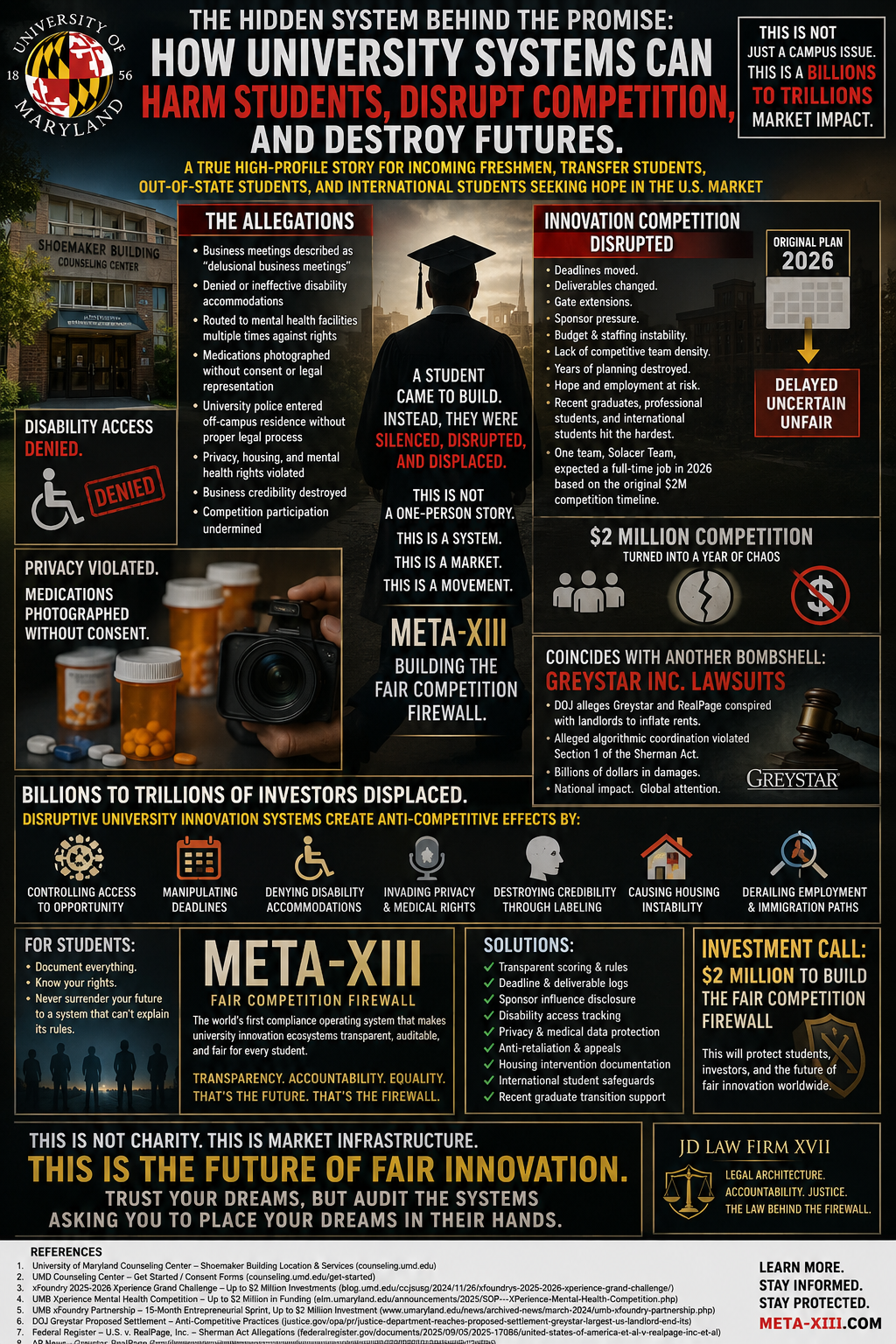
The student alleges that after participating in business and marketing activity connected to a university-sanctioned innovation opportunity, legitimate entrepreneurial activity was reframed by university-affiliated actors as instability. The student reports that business meetings were allegedly characterized as “delusional business meetings.” That phrase matters because it does not merely criticize an idea. It attacks the founder’s credibility. It converts ambition into pathology. It turns meetings into symptoms. It gives an institution a way to discredit the person without ever debating the substance of the work.
For disabled students, that kind of framing can be devastating. A disabled student already has to fight to be seen clearly. They may need accommodations, flexible timelines, documented access, communication support, health-related protections, or disability-informed procedures. When the institution fails to provide meaningful accommodation, the student’s distress may increase. But instead of asking whether the system failed the student, the institution may treat the student’s distress as proof that the student is the problem.
That is where the story darkens.
The student alleges that accommodation processes connected to university disability-access systems failed to provide meaningful support. The student describes denied, delayed, or ineffective accommodations that made academic, professional, and entrepreneurial participation harder. For disabled students, accommodations are not bonus benefits. They are the foundation of equal access. Without them, a deadline can become a trap. A meeting can become inaccessible. A housing issue can become a crisis. A competition can become impossible to navigate fairly.
The student further alleges that, instead of receiving effective access, they were repeatedly routed through counseling and police-centered escalation. The student reports being sent to mental-health facilities multiple times, causing further injury to mental and physical health. This is one of the hardest parts of the story because the public often assumes institutional mental-health intervention is automatically care. But for students who have experienced coercive escalation, facility transport, privacy loss, record creation, police presence, and reputational damage, “care” can feel like a system of control.
A counseling center can be beautiful from the outside and still feel terrifying from the inside if consent, privacy, disability access, and due process are not protected.
The student alleges that university-affiliated counseling personnel photographed their medications without informed consent and without legal representation present. Medication is private. It can reveal disability, diagnosis, treatment, vulnerability, and deeply sensitive health information. Whether the controlling legal framework is HIPAA, FERPA, state privacy law, disability law, counseling ethics, or another applicable regime, the question is not merely technical. The question is moral, legal, and institutional: who gets to document a disabled student’s medical life, where does that information go, and can it be used to affect how the student is seen as a founder, competitor, tenant, or student?
The student also alleges that university police and/or university-affiliated personnel appeared at or entered an off-campus tenant residence without proper legal process, warrant, probable cause, or meaningful respect for housing rights. That allegation raises a boundary question every student should understand before arriving on campus: where does university authority end? A student’s off-campus home is not an extension of the university. It is not a counseling office. It is not a disciplinary room. It is not a competition-management site. If institutional actors cross into a student’s housing life, there must be clear legal authority, documentation, and accountability.
For incoming students, this matters because college life is not separated into neat categories. Housing affects school. School affects health. Health affects employment. Employment affects immigration. Immigration affects mental health. Disability access affects everything. A student who loses housing stability may lose academic stability. A student who loses medical privacy may lose trust in support systems. A student who is labeled unstable may lose business credibility. A student who loses credibility may lose access to venture opportunities. A student who loses a venture opportunity may lose a job pathway.
This is why META-XIII argues that the story is bigger than one student.
The middle of the story is not only about alleged counseling harm, police escalation, accommodation denial, or medication privacy concerns. It is about competition integrity. Student innovation competitions are no longer harmless campus events. They increasingly operate as market gateways. They can determine access to mentors, sponsors, judges, investors, corporate partners, institutional validation, intellectual-property support, company launch resources, employment opportunities, and public credibility.
When a competition is connected to a potential multimillion-dollar pathway, the rules matter. The deadlines matter. The deliverables matter. The judging criteria matter. The sponsor relationships matter. The timeline matters. The institution’s treatment of participants matters.
Public materials connected to xFoundry and university partners have described Xperience-style programs as multi-stage or 15-month venture-building opportunities involving mentors, industry leaders, prototypes, business plans, market validation, startup launch support, and potential investments reaching from $250,000 to $2 million. That public framing matters. It means these competitions are not merely symbolic campus activities. They can become economically material to students who plan their future around them.
According to the student’s account, the surrounding innovation environment allegedly involved shifting deliverables, moving gate deadlines, extended timelines, sponsor pressure, institutional budget concerns, cost absorption, lack of competitive-team density, and possible staffing instability. Those claims require documentation and independent review. But the governance concern is clear: when students build their lives around a competition, moving the goalposts is not neutral.
A shifted deadline may help one team and harm another. A changed deliverable may reward teams with more resources and punish teams relying on accommodations. A delayed gate may protect the institution’s sponsor strategy while disrupting student employment plans. A budget-driven timeline change may affect which schools can participate. A staffing shortage may weaken oversight. A sponsor-recruitment push may influence what kinds of projects are valued. A competition that extends, shifts, or changes without transparent records can distort the field long before judges score final presentations.
This is especially serious for recent graduates, professional students, and international students.
Recent graduates may not have another year to wait. They may need income, health insurance, housing stability, and a credible professional bridge. Professional students may have invested years or decades into a concept and may be relying on the competition to transition from education into full-time work. International students may be navigating immigration timelines, work authorization, sponsorship pressure, and post-graduation employment constraints. For them, a delayed competition is not just a calendar problem. It can become a survival problem.
One team identified in the student’s account is Solacer Team. According to the student, Solacer Team expected a 2026 competition pathway to support a possible full-time job outcome connected to a larger funding opportunity. If a team planned around that expectation, invested labor, built strategy, organized around a timeline, and trusted the process, then any unexplained delay or restructuring could create real harm. It could affect employment planning, investor readiness, immigration strategy, team morale, and the ability to continue building.
That is why this story must be told to students before they arrive.
Incoming freshmen should know that opportunity is not only about enthusiasm. It is about governance. Transfer students should know that entering a new institution means entering systems that may already have hidden rules, informal networks, and administrative histories. Out-of-state students should know that being far from home can make institutional instability more dangerous. International students should know that career promises, startup competitions, and employment pathways must be evaluated with special caution because timing can affect lawful work planning and future status.
The point is not to scare students away from ambition. The point is to teach students to protect ambition with records.
If a university tells students to build, students should ask who protects builders. If a university tells students to compete, students should ask who audits the competition. If a university tells students to seek counseling, students should ask who controls the records. If a university tells disabled students to request accommodations, students should ask what happens when accommodations are denied or delayed. If a university invites international students into innovation pathways, students should ask whether timelines are stable enough to support employment and immigration planning.
If a university brings in sponsors, students should ask whether sponsor influence is disclosed. If a competition changes deadlines, students should ask whether every team was notified at the same time and whether the change was logged. If a student’s business activity is ever described as instability, students should ask who made that characterization, where it was recorded, and whether it affected academic, counseling, housing, police, or competition systems.
This story also coincides with a broader national legal context involving Greystar, RealPage, and alleged anti-competitive conduct in rental housing markets. The point is not to claim that the student’s UMD/xFoundry allegations and the Greystar/RealPage litigation are the same case. They are not presented here as the same case. The point is that students increasingly live inside overlapping systems of institutional power: universities, landlords, property managers, counseling centers, police departments, disability offices, innovation competitions, sponsors, investors, and employment pipelines.
Housing is not separate from education. Housing is not separate from disability. Housing is not separate from mental health. Housing is not separate from entrepreneurship. Housing is not separate from fair competition.
If a disabled student founder’s off-campus residence becomes part of an institutional intervention, and if the student is also participating in a university-backed venture pipeline, then housing stability becomes part of competition integrity. A student who loses housing security can lose the ability to compete. A recent graduate who faces housing pressure can lose the ability to build. An international student facing rent and visa uncertainty can lose the ability to plan lawful employment. A disabled student facing off-campus intervention can experience both physical harm and market exclusion.
This is why investors should pay attention.
The modern innovation market is not only shaped by who has the best idea. It is shaped by who can survive the systems around the idea.
META-XIII’s position is direct: multi-institution university innovation systems can create disruptive anti-competitive effects when they allocate economic opportunity without transparent governance. This does not require a cartoon version of antitrust. It does not require a secret room where competitors explicitly agree to fix prices. Modern competition distortion can happen through systems.
It can happen when institutions control access to opportunity. It can happen when sponsors shape incentives. It can happen when deadlines move without records. It can happen when teams are destabilized before judging. It can happen when disability access is denied. It can happen when counseling systems damage credibility. It can happen when housing insecurity removes a founder from the field. It can happen when international students cannot plan lawful employment because timelines shift. It can happen when professional students and recent graduates invest years of labor into a competition whose rules, gates, and timing become unstable. It can happen when a student founder is not disqualified on paper but is functionally displaced from the market.
That is the central claim: disruptive university innovation systems can distort competition by controlling who remains stable enough, credible enough, accommodated enough, housed enough, funded enough, and institutionally trusted enough to compete.
That is why the Fair Competition Firewall is necessary.
The Fair Competition Firewall is META-XIII’s proposed compliance operating system for university innovation ecosystems, venture competitions, accelerators, sponsors, investors, and student-founder pipelines. It is designed to make fairness auditable.
It would include transparent scoring, published criteria, deadline and deliverable change logs, gate-extension records, sponsor influence disclosures, conflict-of-interest disclosures, equal-access communications, student intellectual-property protections, anti-retaliation reporting, disability-accommodation tracking, international-student planning safeguards, recent-graduate employment-impact disclosures, housing-intervention documentation, medication-privacy safeguards, evidence preservation, appeal workflows, and institutional compliance dashboards.
The firewall creates separation where universities currently risk collapse.
Counseling must be separated from competition evaluation. Disability records must be separated from business credibility. Police contact must be separated from venture scoring. Housing intervention must be separated from market access. Sponsor pressure must be separated from hidden rule changes unless disclosed. Budget constraints must be separated from hidden timeline manipulation. Student medical information must be separated from academic, entrepreneurial, and investor-facing narratives.
Without these separations, the system can harm students while still looking compliant from the outside.
JD Law Firm XVII is the legal architecture paired with META-XIII’s operational architecture. META-XIII builds the system that prevents harm. JD Law Firm XVII frames the legal standards, preserves claims, supports pre-litigation accountability, and helps translate institutional failures into enforceable compliance expectations.
This pairing matters because the future of law and compliance cannot remain reactive. A disabled student should not have to be harmed multiple times before the system learns. A founder should not have to lose credibility before investors understand the risk. A recent graduate should not have to lose a job pathway before timelines are audited. An international student should not have to face career displacement before competition rules become transparent. A team like Solacer should not have to absorb institutional instability before governance is taken seriously.
The standard must be built before the next harm.
META-XIII is calling for a $2 million investment to build and deploy the Fair Competition Firewall. This funding would support platform engineering, secure audit logs, privacy-by-design systems, legal and regulatory review, HIPAA/FERPA/state-law analysis, disability-accommodation workflows, anti-retaliation infrastructure, competition-integrity protocols, deadline and deliverable audit trails, sponsor influence transparency, conflict-of-interest tooling, medication-privacy safeguards, housing-intervention documentation, international-student employment-planning protections, recent-graduate transition safeguards, evidence preservation, institutional pilot deployments, partner onboarding, investor education, and a national fair-competition standard for university innovation ecosystems.
This is not charity. This is not a sympathy campaign. This is not merely a grievance.
This is market infrastructure.
The student venture economy needs a trust layer.
META-XIII is building it.
As part of this public pre-litigation posture, the student and META-XIII call for preservation and review of all records related to the student’s accommodation requests, ADS communications, counseling center contacts, medication photographs, consent forms, police dispatch records, body-camera footage, off-campus residence visits, legal justifications for any off-campus intervention, communications describing business meetings as delusional, communications with xFoundry or UMD innovation personnel, sponsor communications, competition deliverables, gate deadlines, extensions, scoring criteria, budget constraints, staffing reductions, layoffs, corporate partner negotiations, and internal communications concerning the student’s credibility, disability, mental health, business activity, eligibility, participation, housing, or competition access.
They also call for preservation and review of records concerning teams affected by timeline changes, including teams such as Solacer Team, recent graduates, professional students, and international students who may have planned employment, company formation, immigration compliance, or full-time work expectations around the original 2026 competition pathway.
A system that controls records should not also control the truth.
For students, the conclusion is direct: do not surrender your future to a system that cannot explain its rules.
For parents, the conclusion is direct: ask not only whether a campus looks supportive, but whether its processes are documented, appealable, and rights-protective.
For international students, the conclusion is direct: never build employment or immigration hopes around vague institutional promises without written timelines, written criteria, and written contingency plans.
For disabled students, the conclusion is direct: accommodations are not favors. They are access infrastructure. Document everything.
For investors and partners, the conclusion is direct: university venture pipelines may be valuable, but if they are not auditable, they are not investor-grade.
And for universities, the conclusion is unavoidable: beautiful buildings, wellness language, innovation branding, and sponsor logos are not enough. If students can be harmed by opaque systems while being asked to trust those same systems, the institution is not ready for the future it is advertising.
The story began with a promise.
A student came to build, compete, and hope.
The middle revealed how that hope can become fragile when disability access fails, counseling escalates, medical privacy is questioned, off-campus housing boundaries blur, competition deadlines move, employment expectations are disrupted, and teams trust a timeline that may not be protected by enforceable governance.
The ending is still being written.
META-XIII intends to write it as infrastructure.
JD Law Firm XVII intends to write it as accountability.
The Fair Competition Firewall intends to make sure that incoming freshmen, transfer students, out-of-state students, international students, disabled students, professional students, recent graduates, and teams like Solacer do not have to choose between being bold and being protected.
Fair competition is not a vibe.
Student safety is not a slogan.
Employment hope is not a marketing tool.
Trust your dreams, but audit the systems asking you to place your dreams in their hands.
References and Public Context
- University of Maryland Counseling Center public materials identify Shoemaker Building as the Counseling Center location and describe urgent visit access through the front desk during business hours.
- University of Maryland Counseling Center materials describe its hours, contact information, location at Shoemaker Building, and urgent or crisis-response access.
- University of Maryland Counseling Center “Get Started” materials state that students may be asked to complete online forms, including consent to receive treatment, before meeting with a counselor.
- UMD-affiliated public posts about xFoundry’s 2025–2026 Xperience Grand Challenge describe student teams addressing mental health and winning teams launching ventures with investments ranging from $250,000 to $2 million.
- University of Maryland Baltimore public materials describe the Xperience Competition as a multi-stage program connecting students with mentors and industry leaders and competing for funding investments totaling up to $2 million.
- UMB public materials about its xFoundry partnership describe the Xperience Competition as a 15-month entrepreneurial sprint involving prototypes, market validation, business-plan refinement, and winning teams launching businesses with up to $2 million in investment and executive guidance.
- Federal guidance from HHS and the U.S. Department of Education explains that FERPA and HIPAA may apply differently to student health records depending on the record type, institution, and context.
- The U.S. Department of Justice announced a proposed settlement with Greystar Management Services LLC in 2025 as part of enforcement involving alleged algorithmic coordination and anti-competitive practices in rental markets.
- Federal Register materials concerning United States v. RealPage state that DOJ’s complaint alleged Greystar’s agreements with RealPage and other landlords to share information and align pricing violated Section 1 of the Sherman Act.
- Associated Press reporting described a proposed settlement involving Greystar and other property-management firms in litigation alleging use of RealPage’s rent-setting algorithm inflated housing costs, while defendants denied wrongdoing.